


Engineering the future: the evolution of Ocado’s fulfilment robots
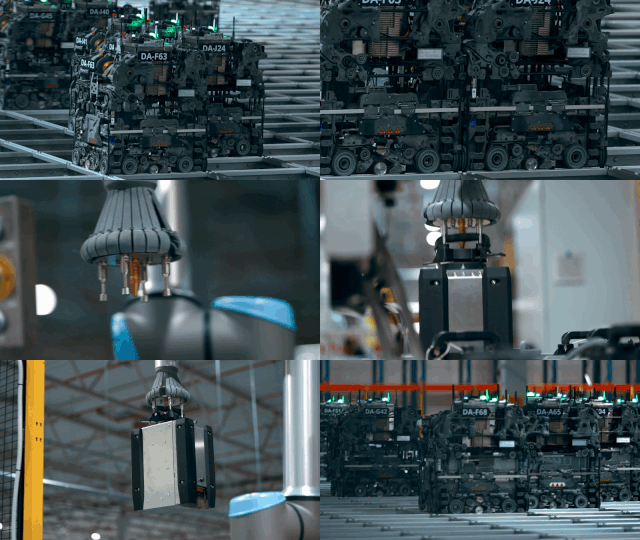
Ocado’s technology is developed to transform online grocery and change the way the world shops.
Today, our solutions are built on a jaw-dropping suite of AI, robotics and automation – from our fleets of retrieval bots to our robotic arms capable of picking and packing tens of thousands of different items.
It took cutting-edge innovation to get here.
The breakthrough concept
Ocado’s first CFC, built in 2002, used cranes, vertical storage, and a vast number of conveyor belts.
We were pleased with our progress. However, scaling this design was tough, as conveyors were slow over long distances, and bottlenecks meant that even small issues could cause a lot of disruption.
Realising the current set-up couldn’t meet our need for scale and reliability, we asked ourselves a question that would change the nature of our business in a fundamental way. What if we turned the entire system on its side and replaced horizontal conveyors with a dense, vertical storage grid?
It was this bold idea that led to the creation of our contemporary CFCs, and the technology at their core. Our sites utilise Ocado robots or ‘bots’, which work together as a swarm to pick up totes of items from the grid and deliver them to pick stations and arms to complete customer orders.
Building the blueprint for automation
When Ocado first set out to transform online grocery, we needed to create a system that could handle the complexity and scale of online grocery. The technologies available at the time appeared promising, but none were proven in real-world grocery operations.
Existing systems simply weren’t built to manage the unique challenges of online fulfilment – from handling short-life and delicate products to managing multiple temperature zones – so we set out to design a solution for our needs.
Early concepts and learnings
Before we could design a new approach, we had to understand the limits of existing ones.
Early automation concepts all came with trade-offs:
- Monorails proved bulky and difficult to maintain
- Conveyor-based systems were slow and led to bottle necks
- Traditional machinery also risked product damage, especially when handling fragile or short-life goods.
Online grocery also comes with the challenges of perishability, with products needing to be managed across multiple temperature zones (ambient, chilled and frozen) while still meeting the speed and precision we required.
These lessons shaped a new direction. We designed a flexible, grid-based system powered by intelligent robots, capable of handling the full range of products, temperatures and demand – at scale.
Bringing our bot and grid system to life
In 2014, testing began at a small, purpose-built facility in Welwyn Garden City, where early prototypes were refined and validated. After extensive development and testing, the 400 Series Bot moved into production.
Introducing this new robotic system into live operations was a major milestone. Engineers and operations teams worked around the clock to monitor, test and refine the system. This pioneering work marked the next step in our advanced fulfilment automation journey.
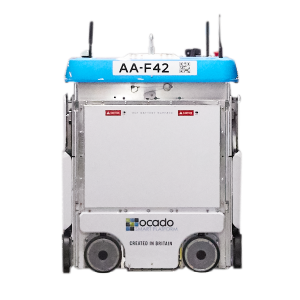
500 Series Bot: a modular approach designed for performance and reliability
In early 2020, we completed development of our 500 Series Bot, the result of years of research and development. Designed and prototyped in-house - the 500 Series had new hardware and software designed for performance and reliability.
The 500 Series boasted a more modular approach, meaning more components could be swapped out and upgraded and maintained smoothly. Together, these improvements represented a major leap forward for Ocado’s automated systems.
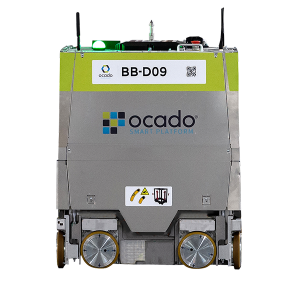
600 Series Bot: the world's most advanced 3D printed industrial product
Our 600 Series Bot is a key outcome of Ocado’s Re:imagined product suite, and marks a significant advancement in automated retrieval systems.
The 600 series began life with a goal of designing a lightweight robot that would reduce costs, and become an enabler for lighter grids within our automated warehouses. With lighter grids, we can enable faster and more flexible site design and installation.
The 600 Series Bot is significantly lighter than previous models. Its low mass is due to its lightweight chassis, which is also a product of advanced design methodologies and additive manufacturing, also known as 3D printing. The 600 Series Bots were designed with a unique ‘all-in’ additive approach – from design to prototype and production, with technology processes built to enable bot production at scale.
The 600 Series Bot, in use in some of our latest Customer Fulfilment Centres today, is at the bleeding-edge of industrial additive manufacturing applications and acts as an enabler for our smaller and faster to build OSP Customer Fulfilment Centres and Store Based Automation formats.
Related content

Explore our newsroom

OGRP: The next game changer
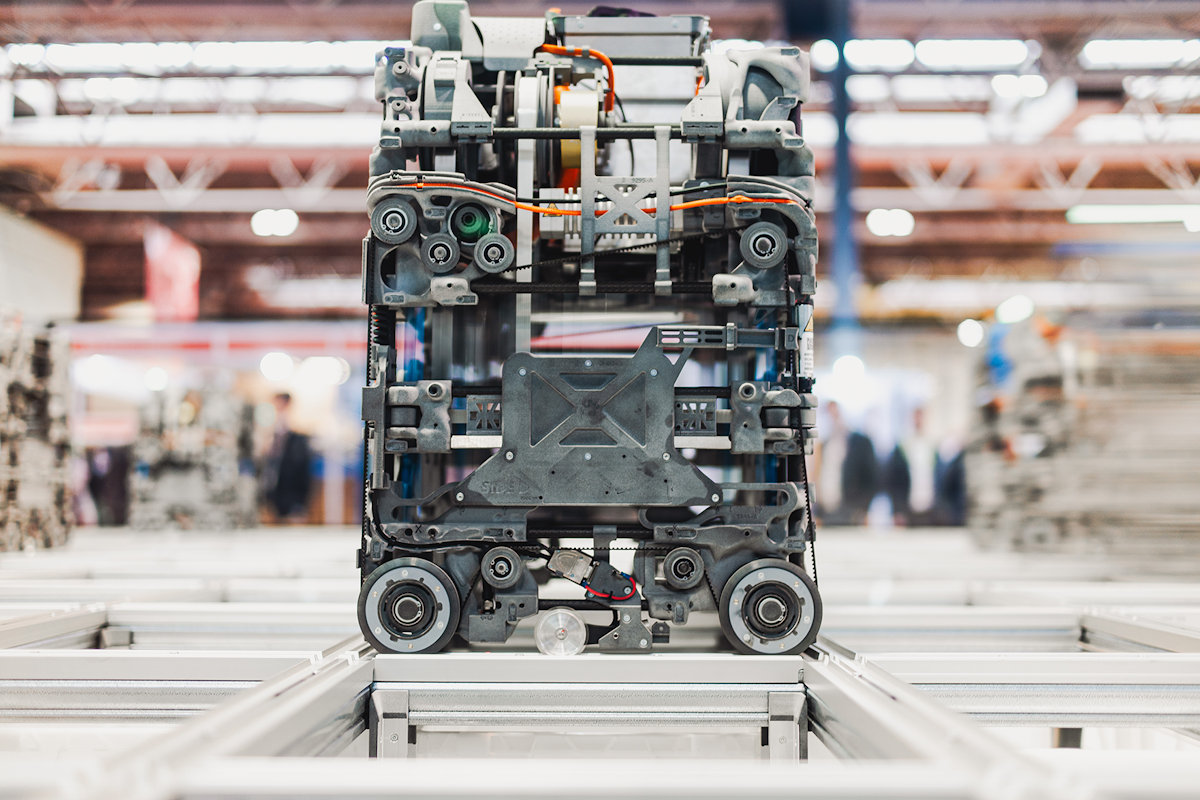
Ocado Group’s 600 Series Bot