

Aggregators and marketplaces - Under the hood with David Hardiman-Evans

The way customers shop for groceries is changing. Alongside retailers’ own webshops and apps, aggregators and marketplaces offer additional channels to reach consumers.
However, aggregators are just one part of a wider e-commerce toolkit. For grocers, the key is determining how these platforms fit into their broader strategy: balancing channel flexibility against critical considerations like customer data ownership and long-term brand proximity.
While aggregators offer useful flexibility for specific, faster on-demand missions, they are not a one-size-fits-all solution.
To understand how they operate, where they fit strategically, and why they matter to Ocado, we sat down with David Hardiman-Evans to get under the hood of the growing aggregator market.
David, what exactly is an aggregator or marketplace, and how does an aggregator order work behind the scenes?
Aggregators and marketplaces are third-party interfaces, such as apps or web shops [Instacart, Deliveroo, Uber Eats JustEat], that allow customers to shop across multiple retailers rather than interacting with a single grocer.
The exact model can vary. Some aggregator models do the whole end-to-end job, where an aggregator worker will pick the product off the shelf and handle the delivery. In other models, the order might be taken on the aggregator site and handed off to the retailer. The retailer's own colleagues pick the products, before the order is collected for delivery or made available for pickup.
Why have aggregators become such an important part of online grocery, particularly in the US?
A lot of this goes back to the fundamental economics of online grocery. Grocery is a very thin margin business, and adding online services, particularly combined with delivery, adds cost for traditional grocers. Startups like Instacart and Shipt filled a gap for home delivery in the US, and removed an expensive cost line for some retailers
This growth was facilitated by the flexibility of the US gig labor market and a higher consumer willingness to pay for delivery services. Aggregators can help retailers introduce delivery services without having to build every part of the operation themselves.
How does the Ocado Smart Platform (OSP) integrate with aggregators, and what opportunities does this create?
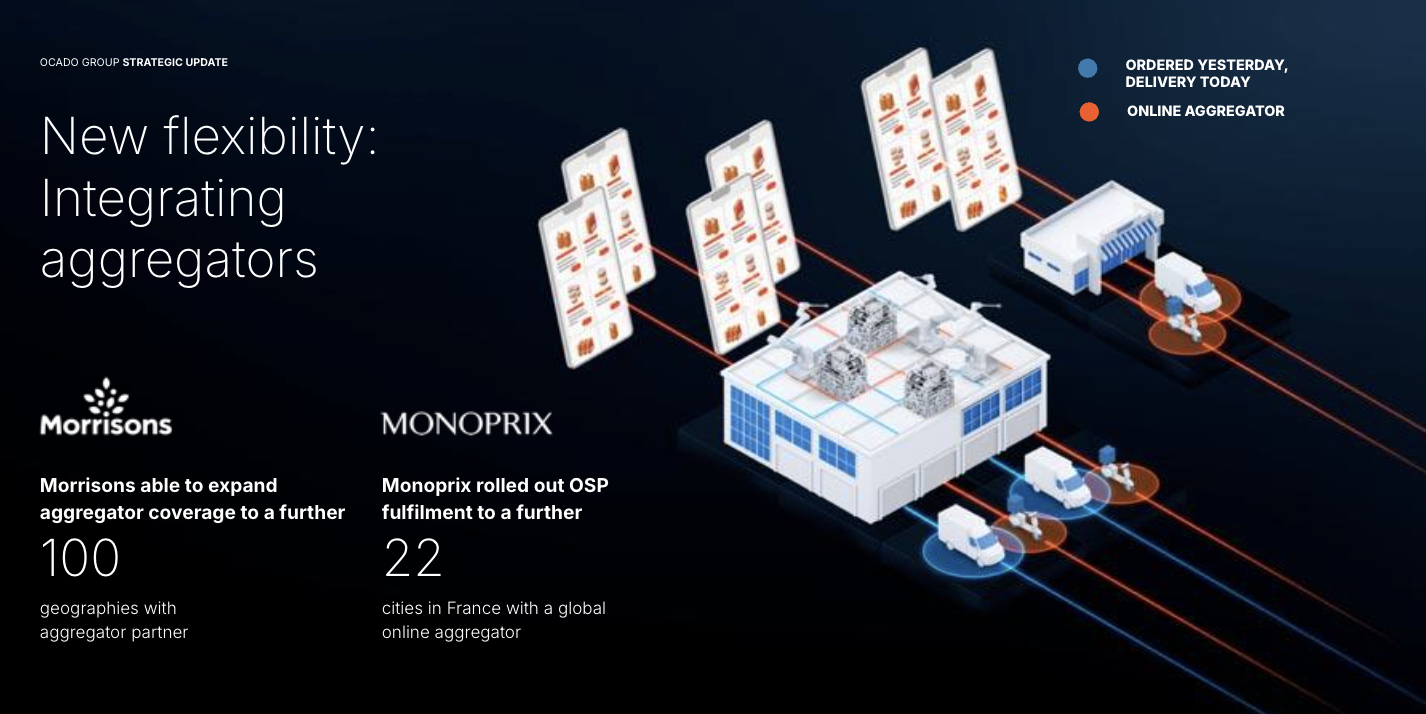
The Ocado Smart Platform already helps our partners manage complex online grocery operations, from receiving orders to picking and fulfilment. By integrating OSP with aggregators, we give our partners the choice and flexibility to connect these channels into their existing setup.
Crucially, when an order placed on a marketplace flows through OSP, retailers get the best of both worlds: they benefit from the last-mile reach and express flexibility of the aggregator, coupled with Ocado’s world-class, proven-at-scale fulfilment solutions. The retailer maintains operational efficiency, accurate picking, and quality control through OSP, while utilizing the aggregator for customer reach and rapid delivery.
How do aggregators complement retailers’ own websites, and what are the strategic challenges?
A retailer might use an aggregator for express orders, as an additional delivery channel, or to enter a new market, while continuing to operate its own website and core online grocery service.
However, it’s unlikely that aggregator services will fully replace mainstream grocery shopping, because customers are often unwilling to pay the price premium associated with on-demand aggregator services.
A critical consideration is customer data ownership. Relying solely on aggregators risks losing direct customer relationships and valuable behavioral data. Retailers require this information for personalised experiences and to monetise insights through retail media, such as supporting suppliers with forecasting and marketing.
Relying too heavily on aggregators creates a potential cycle where retailers lose proximity to their customers, leading to decreased engagement and smaller basket sizes. Additionally, because the aggregator controls the interface and content, retailers have limited ability to signal value to customers or differentiate their offerings effectively.
Looking ahead, how do you see aggregators evolving within the grocery ecosystem?
Aggregators are likely to become an increasingly established component of how groceries reach customers. So, Ocado is integrating them to make sure our partners have the option of using these channels too.
We also have to consider global market variations and regulatory trends. Labour regulations are evolving, with ride-sharing companies seeing increased requirements to classify gig workers as employees. Additionally, in many global markets like Latin America, South East Asia, and South Asia, where labour costs are significantly lower, the aggregator model dominates because traditional first-party retail is often economically unfeasible.
For Ocado, the opportunity is not about retailers choosing between first-party retail and aggregators. It is to help our partners connect the two.
By making OSP easier to integrate with marketplaces, we can support more customer journeys, more fulfilment models and more opportunities for our partners. Aggregators are another important part of the grocery ecosystem, and Ocado can help make that ecosystem work better.
Related content

The Ocado Smart Platform
Ocado Group's Global Partners